

 Manjri Verma
Artists come together through different forms, colours and stories, creating an exhibition that asks visitors not just to look at the art on display, but to pause, connect and feel. There is something about entering an art gallery that makes time move differently. Outside, life continues at its usual pace fast, demanding and full of noise. Inside, a painting asks for something much simpler: a moment of attention.
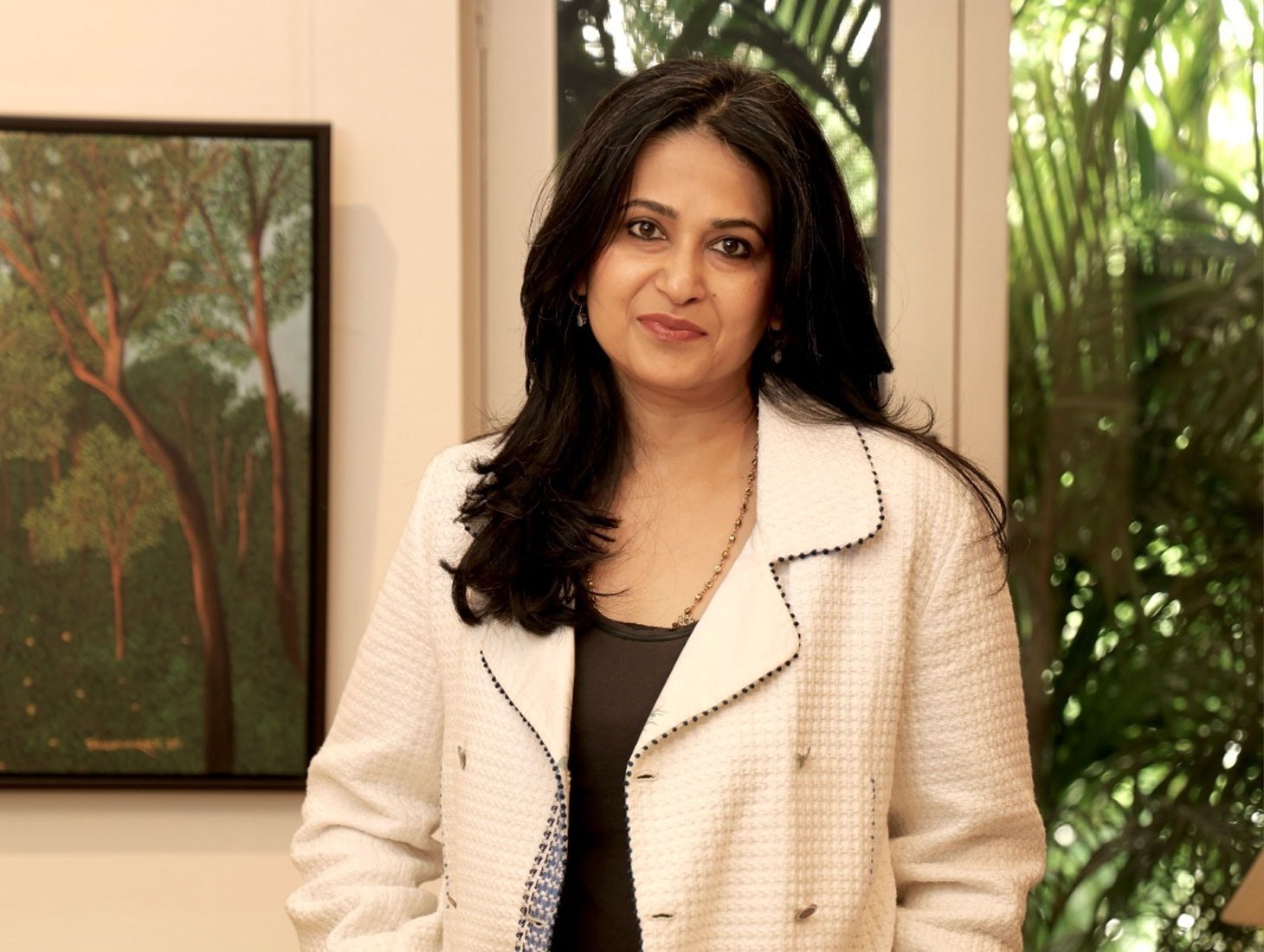
At 105 Arts in Chandigarh, where EMBER is currently on display, four artists have brought together four very different artistic worlds. Their paintings and sculptures differ in style, colour and technique, but each carries its own emotions, experiences and stories. Walking through the exhibition, it becomes clear that the space is not simply about displaying artworks. It is also about the relationship that develops between a work and the person standing in front of it.
We at The North News, visited EMBER and spoke to Mehak Bhan, founder and curator of 105 Arts. For her, that connection is central to the experience of art, “Art belongs to everybody,” she believes. It is a simple idea, but one that shapes much of what she does.
Four words, one idea
The title EMBER brings together four words from four languages — Ember in English, Deep in Hindi, Charāgh in Urdu and Loa in Punjabi. Though different in sound and language, they carry a shared idea of light and flame.
For Mehak, the idea also reflects the diversity of India, where different languages and cultures exist alongside one another. Someone entering 105 Arts may speak Punjabi, Hindi, Urdu, Bengali, English or several languages at once. The gallery, she believes, should feel accessible to all of them.
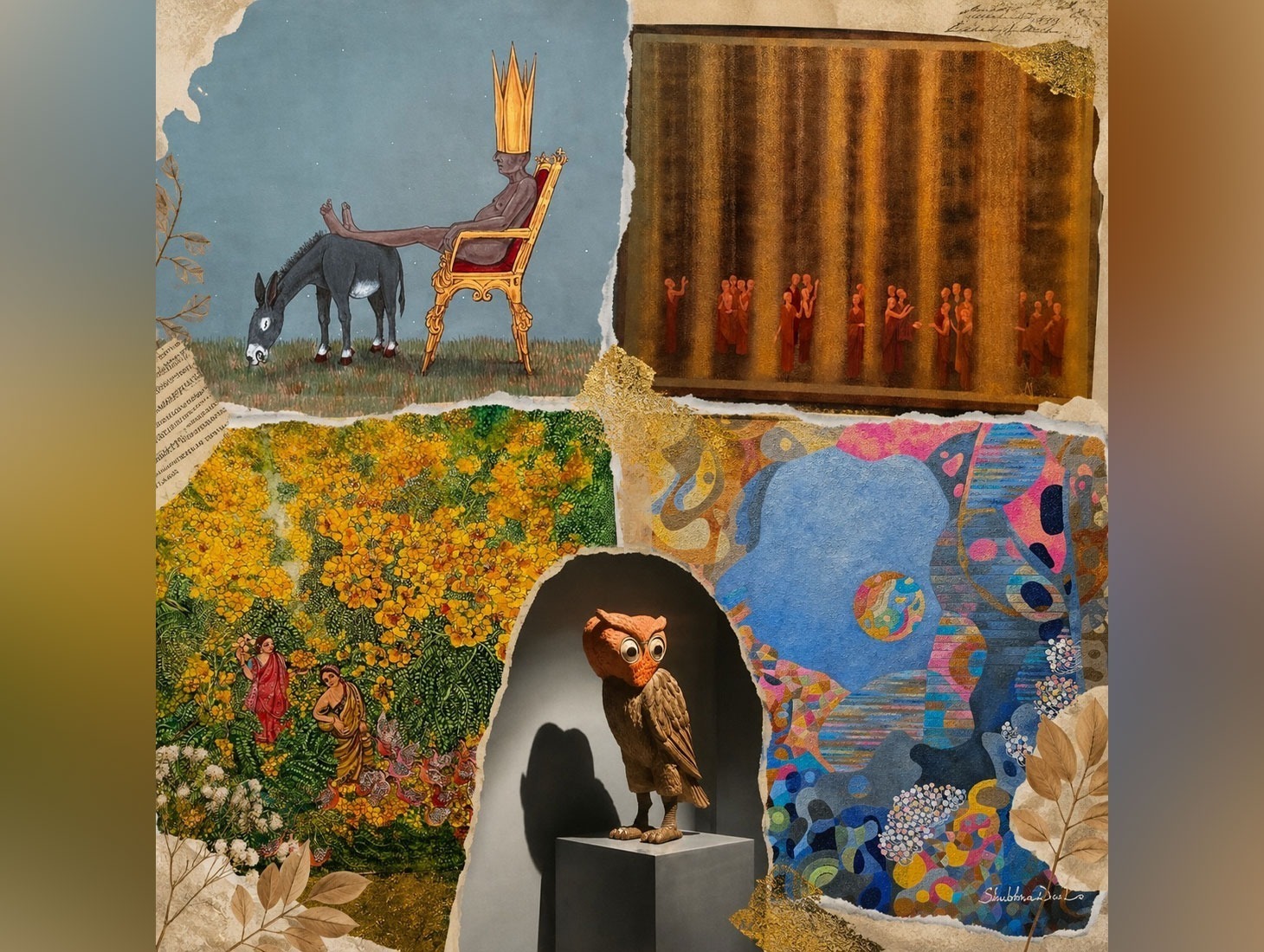
The exhibition underway brings together Kamar Alam, Shubhra Das, Gurmeet Marwah and Chaitali Chanda. Their approaches to art are distinctly different, yet each artist brings a particular way of seeing the world. Mehak describes them as four different lights within contemporary Indian art.
Her own journey into the art world did not begin with formal art training. Born and brought up in Delhi, she studied economics at Lady Shri Ram College and the Delhi School of Economics before teaching economics at Panjab University. Art, however, remained a personal interest. Talking about her journey, Mehak says, “my interest in collecting gradually led to helping friends find original artworks according to their tastes and budgets. That developed into art consultancy and eventually into the creation of 105 Arts.
Five years on, the gallery continues to work with artists from Punjab, Chandigarh and neighbouring regions of Haryana and Himachal Pradesh, while bringing together emerging, mid-career, established and senior artists. For the art world should not be limited to those who already have money, influence or established connections.
Four artists, four ways of seeing
Kamar Alam, the senior-most artist in the exhibition, brings a sense of stillness to EMBER.
His paintings feature monks, boats, trees and water. There is a quietness in them that encourages viewers to slow down. His work is spiritual without being tied to one particular religion. It explores peace, harmony, reflection and the search for balance.
Some of his paintings explore the idea that the universe constantly offers wisdom, knowledge and moments of enlightenment. The question, then, is whether people are calm and aware enough to recognise them. His paintings seem to ask viewers to pause.
That invitation feels particularly relevant in a world dominated by screens, notifications and constant movement. Standing quietly before a painting can itself become an experience.
Shubhra Das creates a very different atmosphere.
Originally from Bengal and now based in Delhi, Das studied at the College of Art, Delhi. She primarily works with oil on canvas, building her paintings through multiple layers. Nature is an important source of inspiration. At first glance, her works can appear abstract, but spending more time with them reveals organic forms, flowers, movement and textures. Her paintings do not reveal everything immediately. They ask the viewer to look again.
Some of her larger works can take six or seven months to complete, depending on their size and requirements. The process reflects an important quality of art — patience. Ideas may arrive quickly, but bringing them to life can take months. Art, in that sense, has its own rhythm.
Gurmeet Marwah brings humour and satire into the exhibition.
His animals — including donkeys, monkeys and owls — can initially make viewers smile. But beneath the humour are observations about society, human behaviour, power, public life, desire and social expectations. The laughter is only the beginning.
His work encourages viewers to look beyond the immediate joke and consider what is being said underneath it. His owl sculptures are another recurring element. The owl has been associated with wisdom, prosperity and good fortune in different cultures. In Marwah’s work, it can also become a symbol of love, focus and self-reflection. Some of his works explore love and obsession, while others question how strongly people are influenced by those around them. The message is subtle: sometimes, people need to listen to themselves.
Chaitali Chanda brings another mood altogether.
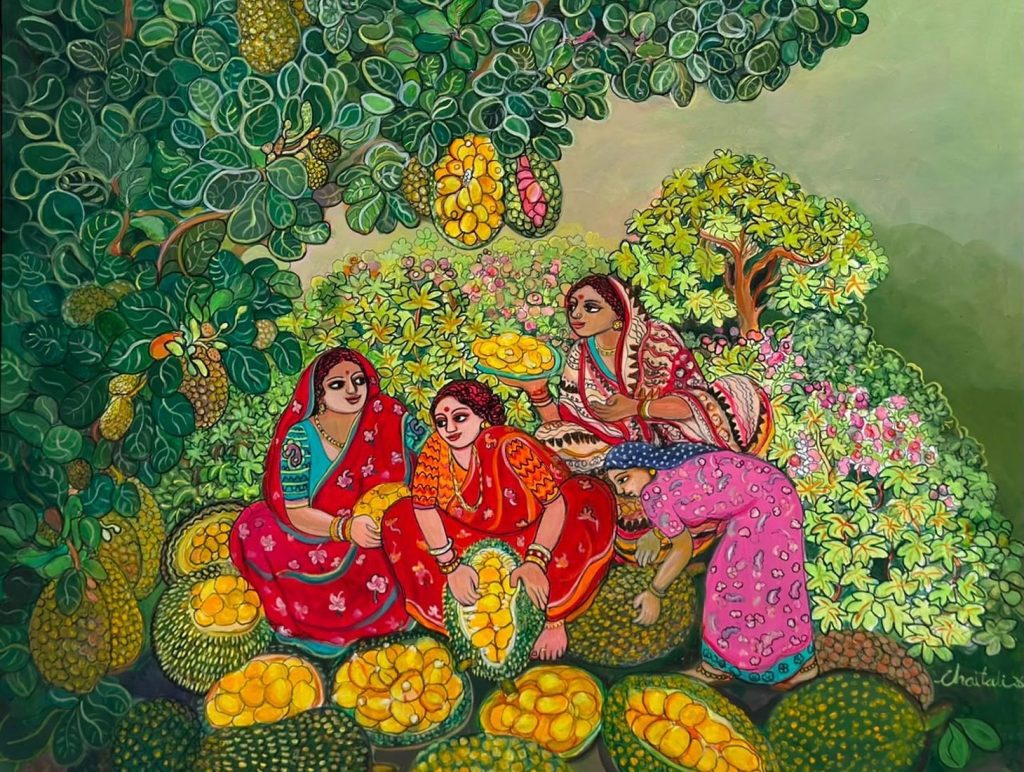
Originally from Kolkata, Chanda approaches painting like a storyteller. Her canvases are filled with colour, nature and scenes from everyday life. Birds, flowers, fruits, trees, fields and people appear across her works. Women are shown working and gathering together, while mango groves, banana plantations and agricultural landscapes create a sense of abundance. The paintings feel full of movement. Their colours are not merely decorative; they help tell the story. Her work carries a strong connection with culture, nature and everyday life, while also touching upon womanhood, motherhood, childhood and joy. Her sculptures carry a similar sense of celebration.
Together, the four artists create a space where silence, abstraction, humour and colour can exist side by side.
And that difference may be one of the most interesting things about EMBER, nods Mehak, “There is no single way to see art. Bhan does not believe everyone should look at a painting and arrive at the same meaning. One person may find peace in an abstract work. Another may see sadness. Someone else may feel curious or may not connect with it at all. All those responses can be valid. Art allows viewers to bring their own memories and experiences into what they see.”
Mehak recalls a time when she would see people standing in front of paintings for long periods and wonder what they were looking at. Later, after becoming more involved with art, she began to understand that experience, “Sometimes, a painting reaches something inside a person that is difficult to explain.The viewer may not always know exactly what has moved them, but they feel it. That emotional connection is an important part of the experience at 105 Arts, when the visitor becomes part of the exhibition,” quips Mehak.
One of the installations at EMBER takes that idea further. Made with 45 bricks, the installation carries words in different languages and invites visitors to consider three questions: What are you made of? Where do you belong? What do you need most right now?
The questions change the role of the visitor. They are no longer simply looking at artwork. They are also looking inward. For Mehak, that is one of the things art can do at its best. It can create a conversation without forcing an answer. It can make people question something they had never questioned before and, sometimes, help them see another person’s point of view.
Making space for new voices
The question of accessibility also extends to artists themselves. Young artists often face uncertainty when choosing art as a career. Parents may worry about financial stability and the future, while society can sometimes treat creative professions as less secure.
Mehak understands those concerns but believes young people need greater confidence to pursue creative careers. Elaborating on her point, she adds, “every civilisation has left behind its art. Paintings, sculptures, architecture and other creative works tell future generations how people lived, what they valued and what they believed. Art, therefore, is not separate from history. It becomes part of how history survives,”
For Mehak, Punjab and Chandigarh have a strong artistic history and an active community of artists. She wants greater attention to be given to artists from the region and believes they deserve a stronger place on the national art map.
That vision is part of what 105 Arts represents — a space for established artists as well as those who are still finding their voice. A flame that asks us to stop. Perhaps that is why the idea of a flame is so fitting for EMBER. A flame does not have to be large to create light. Sometimes, a small spark is enough.
For one visitor, that spark may come from the quiet paintings of Kamar Alam. For another, it may emerge from the patient layers of Shubhra Das. Someone else may find it in the satire of Gurmeet Marwah, while another may connect with the colourful stories of Chaitali Chanda. There is no single correct response. There only needs to be a connection.
Mehak’s message to visitors is simple, “give yourself time for art. Do not look at it merely because it is fashionable. Do not feel that you need to understand everything. Give yourself the freedom to like something, dislike something or change your mind later. Art does not demand the correct answer. It asks us to see,” says she.
As visitors leave 105 Arts, they may not remember every painting or every detail. But they may remember a colour, a face, a landscape, a strange animal, a quiet moment or simply a feeling that stayed with them. They may leave carrying a memory they did not arrive with.
Perhaps that is the real strength of EMBER. It does not simply place artworks in front of people. It creates a moment between the artwork and the person standing before it. Four artists. Four artistic voices. Four different ways of seeing the world. But one flame.
And in a world that often moves too quickly, perhaps the greatest gift art can offer is a reason to stop, a reason to look and a reason to feel.
The Chandigarh Bird Park, located in the heart of Chandigarh near Sukhna Lake in Sector…
The India International Mega Trade Fair (IIMTF) has transformed Parade Ground in Sector 17 into…
The Sacred bond between a brother and a sister is a conglomeration of priceless childhood…
Rajpura based author Jashan Singh Pawar, who previously worked as a feature writer with national…